Blog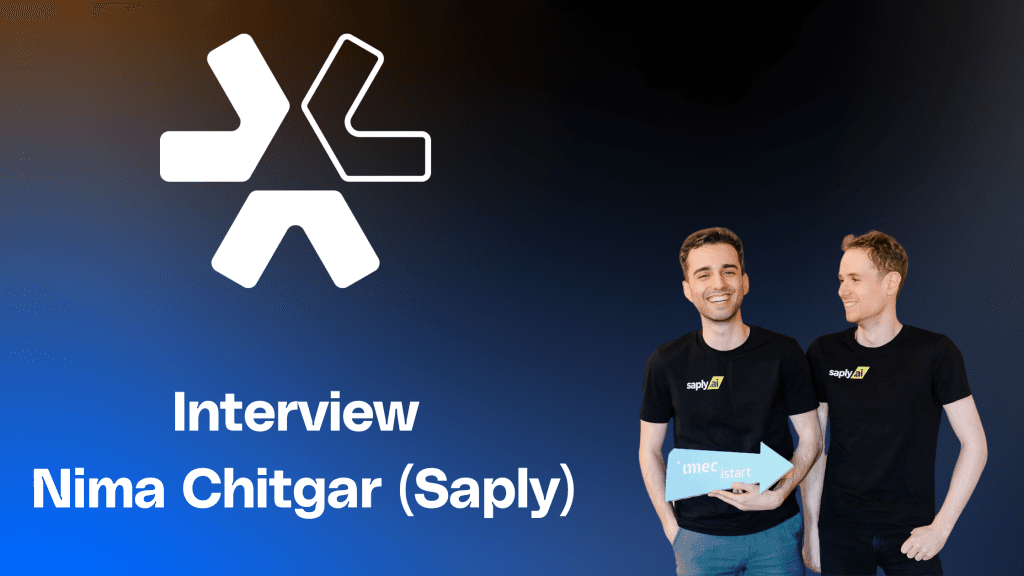
"The Hidden Hours Lost to CV Formatting Are Finally Gone"
Written by: Jeroen Van Ermen from Talent Business Partnerson June 3, 2025
We're delighted to speak with Nima Chitgar, co-founder of Saply, a platform that's transforming how staffing and recruitment agencies create personalised CVs. In this conversation, we'll discover how Nima's journey from freelance consultant to tech entrepreneur led to the creation of a solution that's saving recruiters hours of manual work whilst boosting placement success rates.
———————————-
Company Spotlight: Saply

- Founded: 2023
- Headquarters: Belgium
- Focus: AI-powered CV personalisation for recruitment agencies
- Recent Milestone: €300K funding round (June 2025)
- Key Benefit: Saves 30-90 minutes per CV transformation
From Freelancer to Founder
Lovely to have you with us today. Who is Nima and how did you end up as a 23-year old running Saply, a recruitment tech start-up? Nima: "Since 2020, I've been involved in the HR world because we had founded a startup to match final-year IT students with companies. We built technology around that, like an ATS (Applicant Tracking System). That gave me a lot of insight into how the HR market works, what's involved, how that business fits together. After graduating I worked for a year as a freelancer at the Cronos Group. I'd always had the idea of starting a product company, really a tech startup. Within my journey at Cronos, which is one of the largest consultancies where staffing naturally falls under, I discovered the problem that a tremendous amount of time is spent manually editing CVs. For a consultancy company, the business revolves around people because they're essentially selling people as the product—their knowledge. I thought, 'Can't we automate this?' AI was beginning to emerge more and more, particularly with ChatGPT. So that was a hot market. I explored whether I could connect these two elements and ultimately found a product to solve that problem. Since last year—September 2024—I've been working full-time on Saply. I brought in my partner Guillaume Lameyse, who's something of a tech genius. Together, we've been focusing entirely on getting that product into shape. And here I am now."The CV Transformation Process
Could you perhaps explain how a recruiter within a staffing agency traditionally creates a CV, and how that process looked before, compared to how it looks today thanks to your solution? Nima: "Traditionally, they usually receive CVs in various formats—sometimes PDF, sometimes Word format. When it's Word format, it's better for them because they can easily make changes. But very often they receive PDF CVs, which they then have to convert to DOCX format, Word format. I don't know if you've ever done that, but the entire layout breaks—it's hell to adjust. They spend a lot of time on that. Once they have the Word document, they'll add their own logo and make adjustments. That's the first option. The second option is when they have their own template, particularly companies that want to push their branding forward. They ensure that every CV is converted into a specific template. But that also takes considerable time because you receive a CV with all sorts of different layouts and formats, and you have to convert it each time into a specific layout—the template you have as a company. That involves a lot of manual work and sometimes takes half an hour to an hour just for administrative work to make the CV look good." So you're claiming that thanks to Saply, you can give back half an hour to the recruiter? Nima: "That's for the normal workflow, but sometimes you also have end clients like BNP Paribas Fortis who have their own template, and then you specifically have to fill in that entire template. That can easily take an hour to an hour and a half."
Market Traction and Customer Response
That's quite a serious time saving. How do recruiters react? What traction are you getting in the market today? Nima: "I always say that our product is like a drug addiction—once you start working with it, you can't work without it. The pain point isn't always immediately recognisable, but the moment they start using it, they don't want to work without it anymore. Often, when we've presented ourselves to management, we see that people at the operational level approach management themselves. They actually defend our product, saying, 'That product really helps us not just with efficiency, but also with your revenue.' Because if your CV looks much more personal and better, very targeted towards the project or vacancy itself, you have a greater chance of making a placement. They have less administrative work, so they're simply happier—that's one less worry."Our product is like a drug addiction—once you start working with it, you can't work without it.A happy recruiter with more revenue—that's a dream scenario. What's the reaction from end clients, the companies working with recruiters who receive these personalised CVs? Nima: "There are actually two external factors that have a positive impact. First, the end clients—when they receive, say, ten CVs in the same format and layout, it's very easy for them to recognise which CV fits best with them. Whereas if they receive ten CVs with different formats, that's very difficult to assess immediately in terms of skills and where everything is located. That makes it much more complex. When different agencies submit applications for the same project, the one with a completely consistent layout and template always comes across as more attractive and has a better chance. Additionally, we have the candidates. Sometimes recruiters simply don't feel like it or have too much work, so they send it back to the freelancer or consultant saying, 'Could you adjust this or send it in Word format because I want to be able to make changes?' And they're sometimes frustrated too. Through our process, they don't have to do it themselves anymore. Sometimes the recruiter takes the first steps with our tool, receives a pre-formatted CV, makes a few small adjustments, and they're ready to go. So we've received positive reactions from both end clients and consultants or candidates."
Future Vision and Product Roadmap
You focus specifically on the CV optimisation process. Is there anything else in the pipeline you're working on? How do you see Saply growing and developing further? Nima: "We've just started with a new feature—a note taker, which you probably know exists everywhere now. We automatically take notes from Teams, Zoom, Google Meet. What's super handy is that a CV is two to three pages and doesn't tell everything about a candidate. Sometimes there's a Teams meeting or online meeting to ask more questions. All those notes that take place can be automatically integrated into a CV. So when we notice that the candidate has mentioned certain things during an interview that could be very interesting for the end client, we include that in the story. That naturally makes work easier for the recruiter. Towards the future, we're trying to move more towards an A-to-Z story. From the moment the interview takes place, the first conversations happen, until the product—the CV itself—is actually sent to the end client. We're looking at what else we can implement to automate that process."Industry Insights and Future Outlook
We recently organised a recruitment tech executive dinner where we brought together about ten staffing executives. One thing that came up was that they're certainly willing to test AI “point-solutions” tools and incorporate them into processes. But it also involves change management. How to deal with tool adoption? Nima: "The thing is, it used to be very difficult to make software because there was no AI to help with actual programming. Very quickly, I can create software and tools. This means there are currently many point solutions—tools that have one specific solution and no A-to-Z solution, because that naturally requires much more time and effort to create an end-to-end solution. But because there are now so many point solutions, companies suddenly find themselves with ten or twenty tools and separate subscriptions. They have to invest a lot of time to get into that workflow and simply understand what they use for what. So companies are increasingly less open to using point solutions and want to move more towards an end-to-end solution. They want to pay once for something that does everything from A to Z. Because I knew we were heading towards this market ecosystem, I deliberately chose not to make Saply a standalone tool. We integrate completely with existing systems—that could be an ATS, for example. We're currently investing heavily in Microsoft Office integrations, with Word for example, where we have a plugin for companies that use Word to adjust CVs. They can directly activate our plugin to optimise that CV and put it into their own template. This ensures high adoption and that they can work with it very quickly without having to change too much in their daily workflow." How will the future recruiter's job look with all these AI tools and optimisations? Nima: " I think that AI can take over the administrative tasks, the brainless work that nobody actually wants to do. AI can perfectly replace that. But interviews and personal interactions are primarily what count. Does this person fit with the company culture? Is this someone who has the soft skills to perform the job? That is much more difficult for AI to deal with. I think recruiters will work differently than they do today, but that's not just in HR or within a specific domain. I think that can be applied very broadly— people's working methods will change completely. But that doesn't mean all jobs will disappear." There's sometimes fear that junior recruitment consultant jobs will disappear, but I hear it's more of a strengthening of their roles. Nima: "Absolutely." How do you see the recruitment tech landscape evolving? Nima: "I see many solutions here. I see a new AI tool emerging every day. It's very easy to make software—I mentioned the point solutions earlier. I think there might be a bubble now, but after a while, AI will just be something standard. Everyone will know what it is, everyone will use it daily. Will there still be specific AI companies and stand-alone AI tools... I don't know which direction we're heading, but I think it will all be integrated within larger systems."Investment and Growth Plans
You just announced an investment round. Congratulations! How will that strengthen your further growth? Nima: "We were selected by iMinds and raised €300,000 in total from business angels, with deep expertise in the industry. The intention is to use that money to invest in our product itself, make the technology better, and also invest in internationalisation. We'd like to go beyond the Belgian market. iMinds is a superb partner because they have a very broad network and extensive knowledge. Both my co-founder Guillaume and I are young, so we can learn a lot from experienced people. Being in an ecosystem like iMinds gives you confidence and trust in yourself, because when you face certain obstacles or things you're unsure about—whether to take path A or B—there's always someone who can support you."Being in an ecosystem like iMinds gives you confidence and trust in yourself, because when you face certain obstacles... there's always someone who can support you.———————————- The €300,000 seed funding will fuel three key areas:
- Team expansion to meet growing demand
- Deeper product integrations with existing recruitment tech stacks
- Commercial scaling both domestically and internationally