"I Know How It Shouldn't Be Done" — And That Was Enough to Start
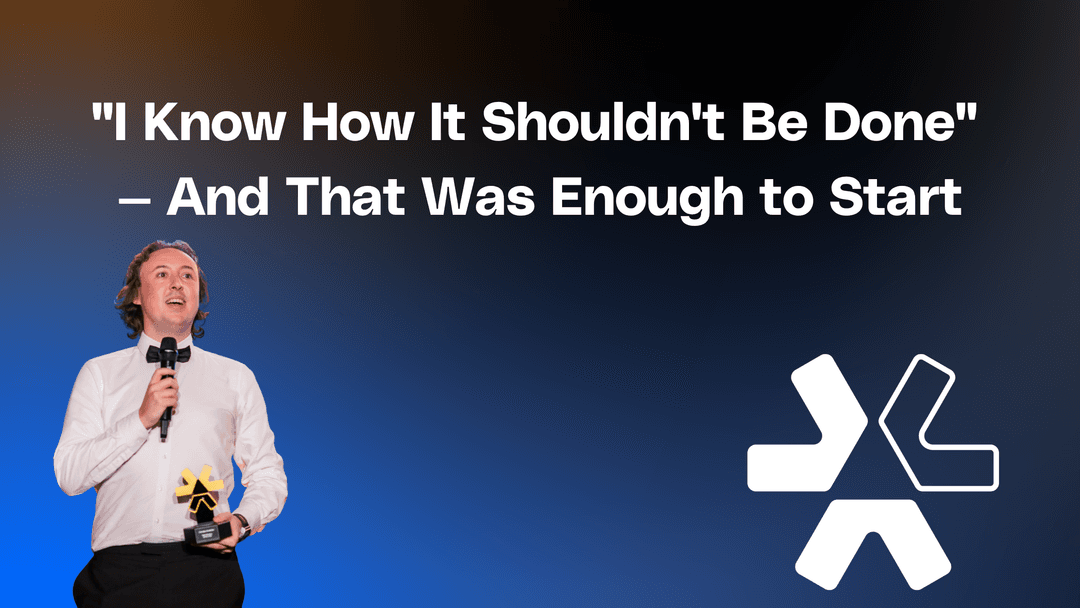
In a country where 72% of employers struggle to fill IT roles, Fabrice Poppe and Joris Van Hoye are betting that the talent companies overlook is precisely the talent they need most.
TLDR
A burnout and fifteen years of glass ceilings led Fabrice Poppe to start The Bee Academy — not with a mission statement, but with the conviction that he knew exactly how not to recruit.
Together with co-founder Joris Van Hoye, they built an IT consultancy that places candidates with a distance to the labour market onto their own payroll, coaches them actively, and absorbs every administrative burden most companies dread.
The Bee Academy won the DEI Award at the 2025 Talent Business Awards — and used the recognition as a credibility springboard with clients, candidates, and future partners alike.
With 20+ consultants active across Belgium and backing from a social impact fund, they now have their sights on something bigger: turning the entire consultancy market upside down.
Fabrice Poppe is not a salesman. He will tell you this himself, unprompted, and with quiet pride. His co-founder Joris Van Hoye is, according to Fabrice, "even less of one than I am." And yet The Bee Academy — the Ghent-based IT consultancy they founded together — has a growing waiting list of candidates, clients stretching from Proximus to petrochemicals to a fleet of ships in five Belgian ports, and a DEI award from the 2025 Talent Business Awards sitting on what Fabrice describes as "the highest shelf in the office."
How did two self-confessed non-salespeople build something that is quietly changing the conversation about who belongs in Belgian IT?
"I Know How Not to Do It"
Fabrice came to IT not through a university degree but through a VDAB vocational training programme. Fifteen years followed — from helpdesk to call centre, to service delivery management — earning a promotion on every project he touched, while consistently hitting invisible ceilings he could never explain. His recruiter's philosophy across nine of those years was blunt: "Set and forget. That was basically the policy."
The breaking point came around 2019–2020, when Fabrice found himself carrying three full-time roles at once — trainer in three languages, service delivery manager, and de-facto head of a support team without enough headcount — while navigating a difficult personal situation at home. The burnout that followed gave him a year to think. His conclusion was simple: "I love IT. I hate how consultants are treated."
When he returned, he went into recruiting — not because he knew how, but because he knew the opposite. "I especially know how it should not be done. That was my only mindset going in." Within months, he had placed around fifteen people. His manager called him in — Fabrice braced himself for criticism — and was told he had outperformed senior recruiters with twenty years of experience.
The Partner Who Was Always There
Joris Van Hoye had been part of Fabrice's story longer than either had realised. He was Fabrice's first employer in IT, and they had stayed in loose contact through the years. When Fabrice began circling the idea of starting something, the conversations kept reaching the same conclusion: "We love IT. Consultancy sucks. And the people we enjoy working with most? Those with a distance to the labour market."
That shared conviction became the founding act of The Bee Academy, launched through the UNIZO starters programme in East Flanders. In 2023, they were named East Flemish Starter of the Year, with national recognition following shortly after. Fabrice laughs recalling the pitch: "It was incredibly awkward. I am completely not a salesman. Against all expectations, we won anyway."
What They Do — and Why It Is Different
Today, The Bee Academy has around twenty consultants on active projects across sectors as varied as Proximus, automotive, petrochemicals, healthcare, and maritime logistics — including one consultant maintaining WiFi networks across 35 ships in five ports. The breadth is deliberate: the right environment, Fabrice believes, matters far more than the job title.
Every consultant is taken onto The Bee Academy's own payroll. The company absorbs all administrative overhead — timesheets, contracts, holiday compliance — that most agencies push back to the candidate or client. They also build an individual development plan for each consultant, structured around a three-way conversation between their coach, the client, and the consultant themselves.
"We take the risks and the burden that companies dread, and we handle it at a transparent price," Fabrice explains. "The result is that both the candidate and the client are satisfied. That is not an accident. It is the model."
The model's proof is in a single story. During a 24/7 crisis period at an automotive client — a team of 25 people — 21 members called in sick at the same time. Only one of The Bee Academy's five consultants was absent. The team stayed operational. Trust was earned in a single crisis.
Unexpectedly, the request has also come in the opposite direction: on four separate occasions, companies have asked The Bee Academy to take over the active support of their own employees with a distance to the labour market — people those companies could not effectively support themselves. "That," says Fabrice, "was something we had never anticipated."
Recognised — and What That Recognition Changed
In November 2025, The Bee Academy won the DEI Award at the Talent Business Awards — the annual gala that brings together the best of Belgium's recruitment and staffing industry to celebrate agencies that deliver real, proven results.
"Getting IT consultants into a gala setting is already a challenge in itself," Fabrice laughs. "Getting them in formal wear is another level entirely." But beneath the humour, the award meant something concrete.
For The Bee Academy, winning was not just a moment of recognition — it was a credibility unlock. "The Talent Business Awards gave us a next step in believability," Fabrice explains. "Towards the labour market, towards clients, towards candidates. It pushed us forward." New partnerships formed on the evening itself, including a connection with a company building accessibility into digital public services. The trophy now sits on the highest shelf in the office, alongside four awards in total — a deliberate reminder, Fabrice says, that each one is a rung, not a destination.
For agencies reading this: that is exactly what the Awards are designed to do. Proof — independently recognised, publicly awarded — does what a sales pitch never can. It opens doors that were previously closed.
AI Is Building New Walls at the Wrong Moment
Fabrice watches the rise of AI screening tools with a specific kind of concern. The Bee Academy uses AI to support its own ATS, but he sees automated candidate filtering as a direct threat to exactly the people he is trying to help.
His clearest example: a woman in her forties, with a migration background, ASD, two years of active self-study, and a new certification every six months. She received zero interviews. Zero feedback. "AI would never have surfaced her," Fabrice says simply. Today, she has celebrated her two-year work anniversary in software development in the textile sector — a placement that required a human conversation, an adapted interview style, and the patience to find precisely the right environment.
"What AI cannot do is make the pitch. It cannot read the room. It cannot find out what environment will unlock a person. That is still my job."
The Mindset They Actually Want to Change
The near-term plan is to expand beyond IT into adjacent sectors where the same patterns — overlooked talent, inadequate support — are clearly visible. Social impact investment fund Trividend came on board in 2024 via a subordinated loan, and scaling the coaching model is the current operational challenge.
But the bigger ambition sits behind the growth targets. Fabrice talks about flipping work-life balance into life-work balance — a subtle but loaded distinction. The average IT consultant tenure is roughly two years before people move on and become more expensive while growing less technically. Support people properly, build the right environment, and let them be more fully themselves at work — and they stay. The investment pays back.
"Our goal is to turn the consultancy market upside down. Not by being against it — but by showing that transparency, openness, and real support make people happier. And when people are happier, they stay longer. And when they stay longer, everyone wins."
There is something else that runs beneath all of this. Fabrice's mother has had a severe physical disability since he was five years old. Doctors told her she would not be able to stand for long. In practice, she ran her own hairdressing salon for thirty years, always with two apprentices in training. "The only thing she ever taught me," Fabrice says, "is that everything is possible. It is just a question of finding out how."
He applies that thinking every single day. On the highest shelf in Ghent the 2025 Talent Business Awards DEI trophy catches the light. It was not given for a good story. It was given because the story had numbers behind it — and because the two people telling it are clearly still very far from the final chapter.
-------
Submissions for the 2026 Talent Business Awards are open until 13 May at talentbusinessawards.com. If you are building something genuinely different in staffing or recruitment, this is the room you want to be in.